Wan 3.0: Prompt Guide
Learn how to direct timed shots with native sound in Wan 3.0
Prompt Guide
Overview
Wan 3.0 is Alibaba's video model. It renders clips of up to 30 seconds at up to 1080p and writes the soundtrack in the same pass — dialogue, room tone, footsteps and score, matched to what is on screen. Write the shot on Omni, or build it from what you attach: up to 10 images, 5 clips and 5 audio tracks, or one webpage or document. Frames animates a still or steers the shot between a first and a last frame, and Edit changes a clip you already have.
How to write the prompt
- Start from subject, scene and motion. A short, open prompt leaves the model room; for control, add the subject's look, the setting, the amplitude and speed of the motion, then the light, the framing, the angle, the lens and the camera move, the visual style, and the sound.
- Write longer clips as numbered shots with time ranges — Shot 1 [0–3s], Shot 2 [3–7s] — so each moment has its own direction and the cuts land where you put them. To stop the model cutting on its own, write "generate a single shot" or "one continuous take".
- Give sound its own lines. A voice is the spoken line plus emotion, intonation, pace, timbre and accent; a sound effect is the object, the action and the ambience around it; music is a style. Turn Audio off for a silent render.
- Say what you do not want heard. Left alone, Wan may add its own dialogue and a music bed: write "No dialogue throughout the entire video" or "No background music" when you want neither.
- On Omni, @mention each attachment in order — @Image 1, @Video 2, @Audio 1 — to say what it is for: this face, that room, this track. Mention a reference again to control exactly how it is applied, borrow a timbre with "use the voice from @Audio 1", or inherit the camera move of @Video 1. Keep it to two characters per video.
- To bring a photograph to life, attach it on Frames. The image already carries the subject, the scene and the style, so describe only the motion and the camera: name the small movements — breath, breeze, cloth, a slow blink — set the pace with an adverb, and write "static shot" to hold the camera still.
- On Edit, name the target and the change: add, replace or remove an element, or change the weather, the palette or the style and add "keep everything else the same". To extend a clip, describe only what happens next.
- Block the shot, the pacing and the sound at 480p or 720p, then re-run the keeper at 1080p.
Direct the clip in beats
Numbered shots with time ranges keep a longer clip from drifting. Give each one a single action and say where the camera is, then either let the cuts carry the story or ask for one continuous take and let the camera carry the transitions.
Prompt
One continuous 30-second low-altitude chase shot, a single unbroken take with no cuts, shot at greyhound speed. On a vast muted-green lawn a distinguished older man in a cream golf outfit lines up a putt at a banana lying on the grass; a slender grey greyhound wearing a knitted cream balaclava snatches the banana at the exact moment of the putt and bolts; the camera drops to ten centimeters off the ground and chases the dog flat-out for the rest of the film. 0-5s: the theft: club swings, the dog's jaws close on the banana mid-stroke and it accelerates away in three strides, ears flat inside the balaclava; the golfer watches it go without any expression; the camera whips down and after it, grass streaking past the lens. 5-11s: across the lawn at full sprint, weaving between motionless cream sheep who do not react; the dog leaps a low hedge, the camera vaulting it a half-beat behind. 11-17s: through a butter-yellow doorway into a whitewashed coastal street, claws skittering on cobblestones, laundry lines whipping overhead; the dog cuts left as a red city bus sweeps past behind it as one long streak of motion blur. 17-23s: out of the street straight into a blush-pink world flooded ankle-deep with glassy water: the dog charges through in sheets of spray, past an elegant woman standing in a red paper boat who turns her head slowly to watch it pass, spray hanging in pink light. 23-27s: up an ochre steppe slope, petals and dust kicked up in its wake, the camera swinging wide alongside as the dog bounds onto a single rounded black boulder at the top. 27-30s: the dog places the banana carefully on the very top of the boulder like a trophy, sits bolt upright beside it, perfectly still, and stares into the lens, deadpan, balaclava slightly askew. Far below on the lawn, the tiny figure of the golfer raises his putter once in salute. Audio: the chase scored by galloping paws on grass, then cobbles, then water, then dust - each surface changing the rhythm's texture; wind rush, one bus whoosh, one splash crescendo, sheep silence; a sprinting string ostinato that locks to the paw rhythm and cuts dead at 27s, leaving only wind and the dog's breathing. Lens 35-50mm, stabilized low tracking, level horizon even at speed. Generate a single shot, one continuous take. Style: editorial, refined, fashion-forward, deadpan surrealist fashion film with high kinetic energy. Grade: slightly desaturated, lifted blacks, compressed milky highlights, low contrast while colors stay legible, light 35mm film grain, faint halation on highlights only, matte print-like finish, warm cream as the neutral instead of pure white. ABSOLUTELY NO on-screen text, no titles, no captions, no logos, no typography of any kind anywhere in the frame. Negative: no harsh contrast, no HDR, no crushed blacks, no clipped whites, no neon saturation, no fisheye, no dutch angle, no smiling or mugging at the camera, no CGI gloss.
Write the sound with the shot
Describe the sound as precisely as the picture. Wan 3.0 matches it to the action, so name what makes each sound and when it happens, give any spoken line its delivery, and say when the music starts and stops.
Prompt
ONE SINGLE CONTINUOUS SHOT — a 30-second take in 4:3, NO cuts: one camera that starts locked-off and then travels one slow half-circle dolly around a barber chair, with the punchlines delivered by moving CLOSE to details, never by cutting. A small old barbershop in a single sage-green world: sage painted walls, cream wainscoting, worn terracotta tile floor, one bentwood waiting bench, glass bottles of green tonic on a shelf, soft morning light through the shopfront glass. In the barber chair, wearing the full striped barber cape, sits a large leafy TOPIARY BUSH. Behind it stands the barber: an older heavyset man, white moustache, putty smock, sleeves rolled. On the bench a middle-aged man in a sage cardigan waits with a potted fern on his lap, reading a folded newspaper. Everyone treats all of this as completely ordinary. 0-6s: static wide; the barber shakes out the cape, tucks it at the bush's 'neck', pumps the chair up twice with two heavy clunks, and asks flatly: "The usual?" — the bush answers with one small polite rustle. The waiting man turns a page. 6-13s: the camera begins its slow half-circle; the barber mists the bush from a brass atomizer — close on the leaves beading with droplets — then combs it with a wide wooden comb, the foliage parting in neat tracks like hair. 13-20s: the trim: precise scissor-work in a quick confident rhythm, leaf clippings falling into a tidy cone on the terracotta tiles; close on the scissors flashing; close on the barber's unhurried, professional squint; the fern on the bench trembles very slightly, watching. 20-26s: the reveal: the barber spins the chair to face the mirror — the bush has been trimmed into a PERFECT POODLE silhouette, pom-poms and all; a held beat of silence; then the poodle-bush shakes itself exactly like a wet dog, shedding two leaves, and settles proudly. 26-30s: the barber whisks the cape off with a matador snap, sweeps once with a broom, and looks at the waiting bench. The man lowers his newspaper, looks down at his own fern with mild concern, and the fern's fronds droop shyly. The barber, deadpan: "Next." Hold on the fern. Audio: cape shake, two chair-pump clunks, mist puffs, comb strokes through leaves, then the scissors settling into a light waltz rhythm that becomes the score; the dog-shake rustle; broom strokes; total silence before "Next."; one page-turn after it. Lens 40-50mm, level, unhurried; sage single-hue world with the terracotta pot and floor as the only warm accent; the joke is never acknowledged by anyone. Art direction (Pika R3): colors soft but vibrant, true to subject, cream as the neutral instead of pure white; lighting one enormous soft source, shadows filled so every texture reads; grade natural and restrained, low-to-moderate contrast, open detailed shadows, subtle fine 35mm film grain, faint halation on highlights only, matte print-like finish, no color cast, no teal-and-orange, no HDR, no crushed blacks, no neon saturation. Every impossible event is physically real and practical-looking — NO glow, NO sparkles, NO particle magic, NO fantasy effects. All faces deadpan, composed, never mugging or winking at the joke. ABSOLUTELY NO on-screen text, no titles, no captions, no logos, no typography anywhere.
Build the shot from references
On Omni an attached image can be the world, the character or the style, and the prompt says which. Give the reference its job, then write the shots as numbered, timed beats and direct the camera and the sound as you would for any other clip.
Prompt
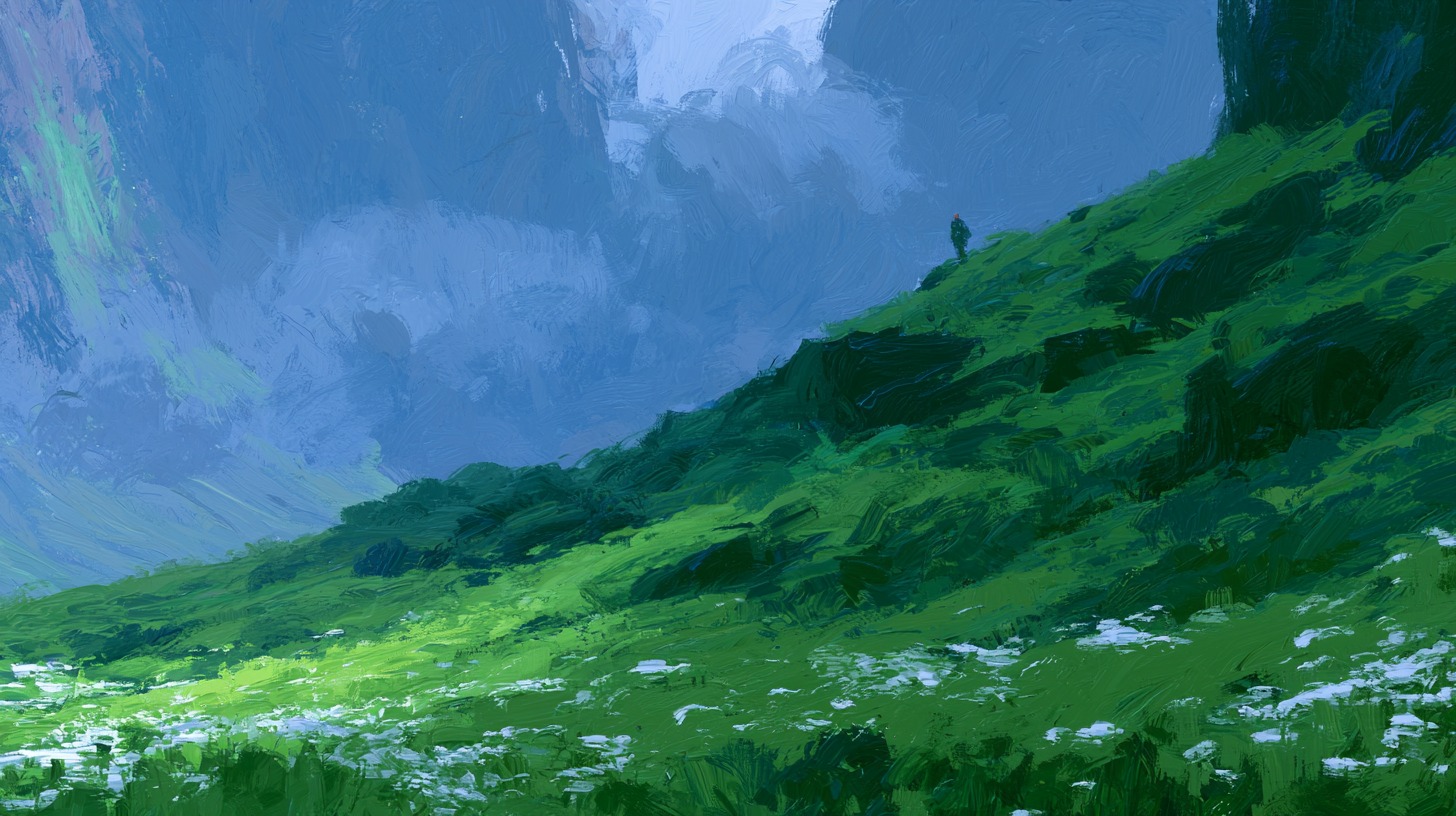
Generate a 30-second, 16:9 hand-painted gouache animated short: a man climbs a hill at golden hour and reaches a single grave at the summit. ART STYLE — hold this exactly in every frame, it is the contract: hand-painted gouache landscape painting. Thick opaque pigment, every brush mark visible and left unblended. Directional flat-brush and palette-knife strokes that follow the slope of the terrain. Saturated emerald and spring-green hillside against cool slate-blue and lavender haze; white flecked wildflowers scattered through the grass; deep forest-green shadow masses. Strong atmospheric perspective — distant cliff walls flatten into pale blue mist. NO outlines and NO line work at all: form comes entirely from brush mark and value. Matte pigment throughout, no gloss, no gradient blending, no airbrush, no digital smoothing, no photorealism, no text or watermarks. The figure stays small and simplified, a painted silhouette rather than a rendered character. ANIMATION STYLE — this is equally binding: hand-painted frame-by-frame traditional animation running at 12 frames per second, on twos. Every frame is a separately painted gouache painting, so the surface never sits still — the whole image BOILS. Every 2 to 4 frames the brush texture, edge placement and pigment grain visibly shift and re-form, because a human repainted them. Outlines of hills, clouds and the figure wobble and breathe frame to frame. Colours flicker very slightly between adjacent frames as pigment density varies. This boil must be constant and present in every single shot, including the still ones. Do NOT smooth, interpolate, stabilise or motion-blur between frames — the judder and the boil ARE the style. No 24fps smoothness, no CG tweening. CHARACTER: Image 1 is the world and the style authority. The climber is a lone man in a dark coat, small in frame, painted as a simplified silhouette with no facial detail except in the two close-ups described below. Shot 1 [0-4s]: THE START. Wide. The man begins climbing the steep green slope, tiny against the vast misty valley and pale cliff walls behind him. Late golden light rakes across the grass. Shot 2 [4-7s]: B-ROLL — GRASS. Extreme close-up. Wind ruffles through the grass blades and white wildflowers, stems bending and springing back, painted marks reshaping with every frame. Shot 3 [7-10s]: THE CLIMB. Medium-wide. He works his way up the slope, leaning into the gradient, one hand steadying against the ground. The valley falls away behind him. Shot 4 [10-12s]: B-ROLL — BIRDS. Medium shot of the pale sky. A loose scatter of birds crosses the frame, painted as quick dark strokes, wheeling once. Shot 5 [12-15s]: B-ROLL — BREATH. Extreme close-up on the climber's mouth and jaw. He is breathing hard and open-mouthed, warm breath faintly visible in the cooling air, a strand of hair stuck to damp skin. Shot 6 [15-18s]: THE LAST PUSH. He crests the final ridge, pushing off his own knee with one hand, head down, then slowly straightens up. Shot 7 [18-22s]: THE REVEAL. Reverse angle. At the summit stands a single weathered stone grave marker, alone on the grass — and behind it the sun is setting low, the whole sky glowing in soft amber, apricot and rose, warm light haloing the edges of the stone. He stands motionless. Shot 8 [22-26s]: THE SIT. Wide shot. He holds still for a beat, just taking it in, the wind moving the grass around his legs. Then he walks slowly forward and sits down on the ground in front of the grave marker, facing it. The sky glows on, gold fading gently into rose. Shot 9 [26-30s]: THE GREETING. Close-up on his face in three-quarter profile, the only time we see him clearly — weathered, tired, eyes glistening, the warm evening light soft on his cheek. He looks at the stone, and a small, tender smile finds him. Quietly, warmly, his voice low and catching slightly, he says: "Hey, it's been a while." He breathes out and keeps his eyes on the stone. Hold on his face to the final frame. CAMERA: patient and mostly locked, letting the painted frames do the work — a slow drift with him on the climbing shots, static for the three b-roll inserts, a steady hold on the wide of him sitting, and a slow, gentle push-in on his face for the final line that settles and holds. No handheld shake, no fast moves. AUDIO: no music until the reveal at 18s, then a single sustained cello line that swells gently, softens to almost nothing under his words, and resolves on the final frame. Wind moving through grass, boots on soil, laboured breathing in the breath close-up, distant birdcalls, and the deep quiet of high open ground. The only dialogue in the entire video is his single quiet line at the end, in his own voice, low, gentle and sentimental: "Hey, it's been a while."
Animate a still on Frames
The photograph sets the subject, the scene and the style, so spend the prompt on motion and camera. Say how each element moves and how fast, name one camera move or write "static shot", and let Wan write the audio to match.
Edit a clip you already have
On Edit the clip is the description and the prompt is the instruction. State the target and the action — replace the cat with a dog, change to an overcast day, have the man pick up the cup and take a sip — and add "keep everything else the same" when one element is the target. To extend the clip, describe only what comes next.